AI Agents Are My Dev Team — I Just Manage Them
May 19, 2026
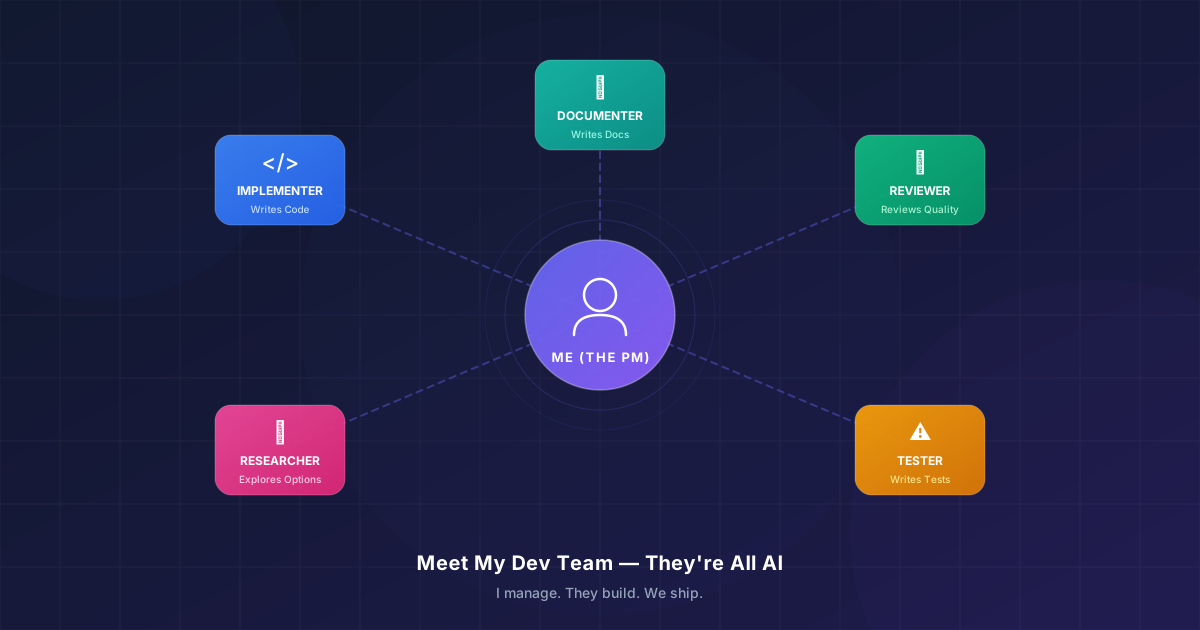
So here's a weird thing to say out loud: I manage a team of developers, and none of them are human.
Recently I became a Claude Certified Architect. People asked me what that means. The short version? I stopped writing most of my code by hand and started treating AI agents like a team of developers — with me as their project manager. And honestly? It's the most productive I've ever been in nearly a decade of building software.
Let me show you what this actually looks like.
Wait, What's a Claude Certified Architect?
Fair question. It's not just a fancy badge. Anthropic's Claude Certified Architect credential means you can design and build production-grade systems where AI agents do real work — reliably, securely, and at scale.
It covers things like:
- System design with AI agents baked in as core building blocks
- Prompt engineering at the architecture level — not just "hey write me a function"
- Safety and error handling when AI is in the loop
- Multi-agent orchestration — getting several AI agents to collaborate on the same task
Here's the thing: anyone can ask ChatGPT to write a function. The certification taught me how to build systems where multiple agents work together to ship a complete feature — from planning to deployment. That's a very different skill.
The Mindset Shift That Changed Everything
For almost 10 years, my identity as a developer was tied to the code I wrote. Every function, every component, every API route — handcrafted. And I was proud of that.
But here's what finally clicked: writing code and building software are not the same thing.
Building software is about decisions — what to build, how to structure it, what trade-offs to accept, where the risks hide. The actual typing? That's just execution. And it turns out AI agents are really, really good at execution.
Here's how my day-to-day shifted:
| Before (Me, the coder) | Now (Me, the PM) |
|---|---|
| Write every line myself | Write specs, delegate to agents |
| Debug by staring at stack traces | Ask an agent to diagnose and suggest fixes |
| Write tests after the feature (if I'm being honest... sometimes never) | Agents generate tests alongside the feature |
| Context-switch between design and coding all day | I focus on architecture, agents handle the typing |
| One thing at a time | Multiple agents running in parallel |
I know what you're thinking — "that sounds lazy." It's not. It's the same thing a lead engineer does when they delegate to their team and focus on system design and code review. I just don't have to schedule any standups.
Meet My "Team"
I treat my AI agents like specialized developers. Each one has a clear role, and I assign tasks based on that role. Just like a real team — except nobody asks for PTO.
🔹 The Implementer
My main coding agent. I hand it detailed specs — think well-written Jira tickets — and it cranks out the code. I use Claude's extended thinking and agentic coding for complex, multi-file work.
What I hand off: Feature code, components, API routes, schema changes.
🔹 The Reviewer
After code comes back from the Implementer, I run a separate review pass. I prompt an agent to act as a senior engineer doing a code review — hunting for bugs, security holes, performance issues, and code smells.
What I hand off: Code reviews, security checks, performance audits.
🔹 The Tester
This one writes unit tests, integration tests, and edge cases. I give it the feature context and it generates a test suite I can validate and run.
What I hand off: Test generation, edge case coverage, test analysis.
🔹 The Researcher
Need to evaluate a library? Understand a new API? Compare two architectural approaches? I send the Researcher to dig in. It comes back with a structured summary so I can make a decision in minutes instead of hours.
What I hand off: Library comparisons, API docs, architecture trade-off analysis.
🔹 The Documenter
Let's be real — documentation is the thing that always gets skipped when deadlines are tight. Not anymore. My Documenter writes READMEs, inline comments for tricky logic, and API docs straight from the code.
What I hand off: READMEs, API docs, changelogs, inline comments.
What a Typical Day Looks Like
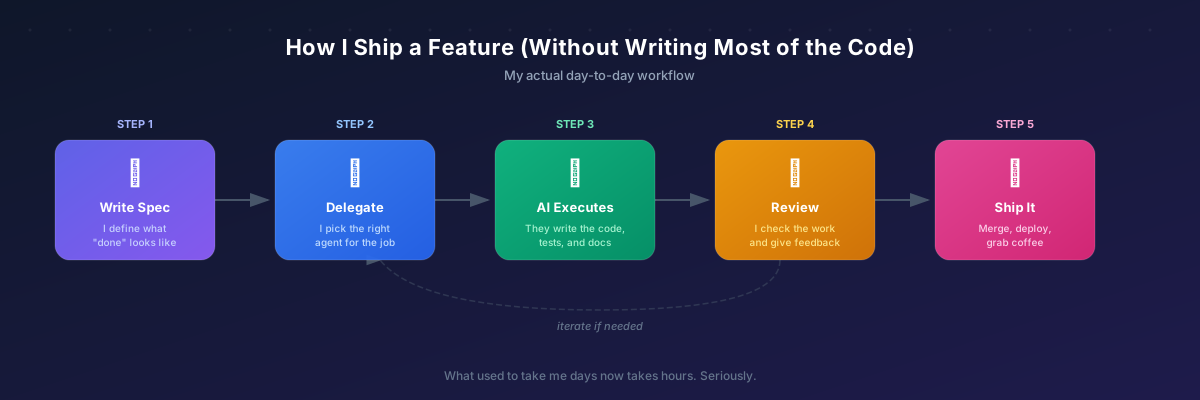
Let me walk you through an actual feature build with this setup.
Morning: I Think, I Sketch, I Plan
I start by defining the feature at a high level. What's the user story? Which components are involved? What are the API contracts? Sometimes I sketch on paper, sometimes in a markdown file.
This part is everything. The quality of what your agents produce is directly proportional to how well you define what you want. Garbage spec in, garbage code out.
Mid-Morning: I Hand Out the Work
I break the feature into tasks and delegate. Say I'm building a dashboard:
- Task 1: "Create a
/api/dashboard/statsendpoint that aggregates user activity from the past 30 days. Return total sessions, avg duration, and top 5 pages. Use the existing Prisma schema." - Task 2: "Build a
DashboardStatsReact component that fetches from that endpoint and renders cards with Tailwind. Include loading and error states." - Task 3: "Write unit tests for the API endpoint: valid response shape, empty data, and date range edge cases."
Notice how each one reads like a solid ticket — clear scope, specific requirements, enough context to make good choices. This is the skill. Not the coding. The specifying.
Afternoon: I Review Everything
This is where 10 years of experience pays off. I review every piece of output like a tech lead reviewing PRs:
- Does this follow our project's patterns?
- Any security issues?
- Is the error handling right?
- Will this scale?
I almost never accept the first draft as-is. Usually takes one or two rounds of feedback to get it production-ready. But that's still way faster than writing it all from scratch.
Late Afternoon: Merge, Test, Ship
Once everything's reviewed and polished, I integrate the pieces, run the full test suite, and deploy. A feature that used to take me two or three days? Done in four to six hours.
Then I grab a coffee. I've earned it.
The Secret Sauce: Writing Good Specs
Here's the biggest thing I've learned as an AI project manager: vague prompts get vague results. You wouldn't accept a one-line Jira ticket from your PM. Don't give one-line prompts to your agents.
The difference is night and day:
✅ This Gets Great Results
"Refactor
UserProfileto use React Server Components. Keep the edit form as a client component with'use client'. The server component should fetch user data using the existinggetUserByIdfromlib/users.ts. Maintain all existing props and don't break the current test suite."
❌ This Gets... Something
"Convert UserProfile to server component."
The magic ingredients? Context, constraints, and a clear definition of done. The more you give, the fewer rounds of back-and-forth.
My Go-To Spec Template
Every task I delegate follows this structure:
- Objective — What are we building or changing?
- Context — What does the agent need to know about the codebase?
- Requirements — Specific acceptance criteria. Be precise.
- Constraints — What should it NOT touch? (e.g., "Don't modify the database schema")
- References — Files, functions, or patterns to follow.
This template alone cut my iteration cycles in half. When the agent has clear guardrails, the first draft is surprisingly close to what I need.
The Real Results
I'll skip the fluff and just share what actually changed:
- 3-4x faster feature delivery — agents work in parallel, I focus on review
- Fewer production bugs — having a dedicated Reviewer and Tester catches stuff I'd miss doing it all solo
- 70% of my time on architecture — used to be the opposite (70% coding, 30% design)
- Documentation actually exists now — because it's not a chore I'm doing at 6 PM on a Friday
- Way less burnout — offloading the repetitive stuff frees my brain for the interesting problems
Want to Try This? Here's My Advice
1. Start Small
Don't try to delegate an entire project on day one. Start with one utility function, one test suite, one component. Build the muscle.
2. Always, Always Review
AI agents are powerful but not perfect. Never ship code you haven't read. Treat agent output like a junior developer's PR — review everything. This is non-negotiable.
3. Save Your Best Prompts
You'll discover specs that consistently nail it. Save them. I have a prompt library for common tasks — API routes, React components, database migrations, test suites. It's like having a team playbook.
4. Good Architecture = Good AI Output
The cleaner your project — consistent patterns, clear conventions, well-organized files — the better your agents perform. They pick up on your codebase's style. A messy repo gets messy output.
5. Stay Curious
New models, new tools, new workflows drop constantly. The certification was a milestone, not a finish line. Keep experimenting.
Here's What I Really Think
AI isn't going to replace developers. But developers who learn to manage AI agents will absolutely outpace those who don't.
Our role is evolving. We're going from being the people who write all the code to being system architects and AI orchestrators — people who understand the technical landscape and know how to direct AI to build great software.
Getting Claude Certified gave me a framework to do this properly. But the real change was in my head: I stopped thinking of myself as a coder and started thinking of myself as a project manager for a team of AI agents. Together, we ship faster than I ever could solo.
If you're on the fence about bringing AI into your workflow — just start. Write one spec. Delegate one task. Review the output. Iterate. You'll never look back.
Get in Touch
Want to collaborate or just say hi? Reach out!