Why AI Projects Fail at Implementation: The 3 Checkpoints Nobody Thinks About Until It's Too Late
November 8, 2026
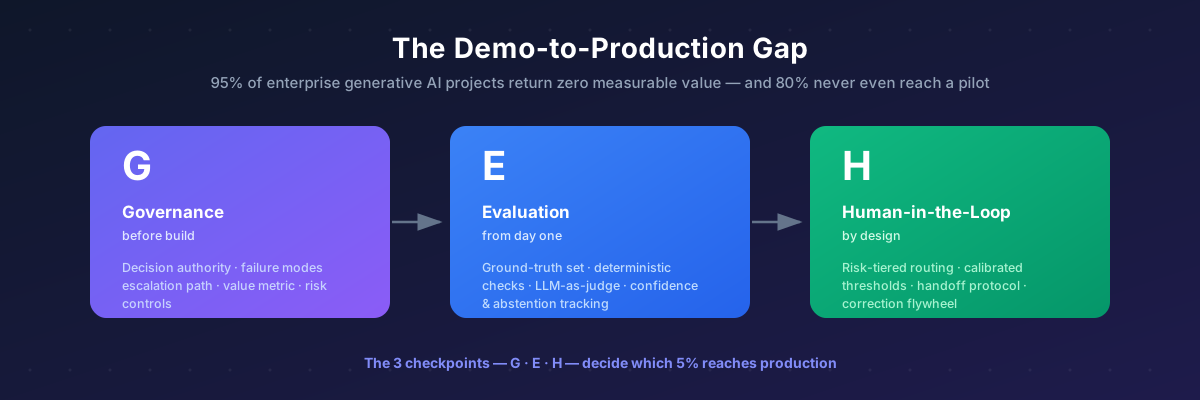
Enterprise AI projects don't fail because the models are bad. They fail because almost nobody addresses three things before the first line of code: who can override the system when it's wrong, how you'll know when quality degrades, and when a human must take over. The model is the easy part. The failures live in the gap between the demo and production — and that gap is closed by governance, evaluation, and human-in-the-loop design, not by a better prompt or a bigger model.
I call these the G-E-H checkpoints — Governance before build, Evaluation from day one, Human-in-the-loop by design. They aren't theoretical. They're the same gaps that independent research keeps finding across failed and stalled enterprise AI programs, and they're the difference between the small minority of custom AI systems that reach production and the long tail that never does.
The Problem: The Gap Between “It Works” and “It's in Production”
The data on the pilot-to-production gap is now consistent across independent studies, and it isn't comforting.
MIT's Project NANDA team published The GenAI Divide in July 2025 — a review of more than 300 publicly disclosed AI initiatives, structured interviews with 52 organizations, and surveys run across the first half of 2025. The headline finding: despite an estimated $30–40 billion in enterprise generative AI investment, 95% of organizations are getting zero return — no measurable impact on the P&L. The funnel tells the story better than the headline does:
- 60% of organizations evaluated enterprise-grade AI systems
- 20% of them reached a pilot stage
- 5% reached production
McKinsey's 2025 State of AI survey (1,993 respondents across 105 countries, fielded June–July 2025) shows the same shape from the adoption side: 88% of organizations now use AI regularly in at least one business function, up from 78% a year earlier — but only about a third have begun scaling their AI programs, and just 39% report any EBIT impact from AI, most of it under 5% of EBIT. McKinsey defines “AI high performers” — the organizations that attribute 5% or more of EBIT to AI and report “significant” value from it — as roughly 6% of all respondents.
And the trend toward agentic systems isn't changing the shape of the problem. Gartner predicts that over 40% of agentic AI projects will be canceled by the end of 2027, citing escalating costs, unclear business value, and inadequate risk controls as the drivers.
Here's the part worth sitting with: these are three different institutions, doing independent research, and they point at the same three failure causes.
| Study (2025) | What it found | Maps to |
|---|---|---|
| MIT NANDA, The GenAI Divide | Most enterprise systems fail due to brittle workflows, lack of contextual learning, and misalignment with day-to-day operations | Checkpoint 1 and 3 |
| McKinsey State of AI | High performers have defined processes for when model outputs need human validation; workflow redesign is among the strongest value drivers | Checkpoint 3 (and 2) |
| Gartner press release | Cancellations driven by unclear business value and inadequate risk controls | Checkpoint 1 (and 2) |
None of these is a model-quality problem. Every one of them is an implementation problem — a decision that has to be made, or left unmade, before the first line of code exists.
What the gap actually costs
The direct cost is the investment itself: engineering time, vendor fees, data work, and integration effort that stops producing value at the pilot wall. But the second-order cost is worse and rarer: a failed AI program retires the organization's ability to fund the next one. The operations team that watched a demo become a liability stops trusting the next demo. The CTO who inherited a system nobody can measure or control stops approving the next request. In practice, the second AI project is always harder to sell than the first, because the first one left a scar nobody documented.
That's why the fix has to be upstream. You can't patch governance into a production system after the incident that exposes its absence, and you can't add measurement to a workflow that was never instrumented to be measured.
What Most Teams Get Wrong
1. Model first, everything else later
The standard kickoff sequence runs like this: pick a model, prompt-engineer or fine-tune it, demo the happy path, celebrate. The questions that actually decide production readiness get deferred to a “phase two” that never gets budget:
- When the system is wrong, who can override it — and how fast?
- What are the top failure modes, and what does each one do to a real business process?
- How will you know, in a number you can chart, that quality degraded?
- Which outputs are allowed to act automatically, and which must be reviewed?
Every one of those is a governance, evaluation, or human-in-the-loop question. None of them can be answered cheaply after launch, because the answers change the architecture.
2. Demo theater
A demo is a curated sample. The inputs are the ones the system handles well, the model is in a good mood, and the edge cases are invisible. Demos succeed by construction. What the demo never shows is the failure distribution — and the failure distribution is the actual product.
MIT's report is blunt about what happens when the real distribution arrives: enterprise-grade systems, custom or vendor-sold, are “quietly rejected,” most failing due to brittle workflows, lack of contextual learning, and misalignment with day-to-day operations. That's the 80% of organizations that evaluate the technology and then walk away. The workflow underneath the demo wasn't the workflow the business actually runs.
3. Retrofit syndrome
Governance, evaluation, and human review are almost always treated as things you add after the system “works.” The order matters, because each one is cheaper and more effective earlier:
- Governance retrofits mean discovering, after the incident, that nobody decided who owns a certain class of output. You fix it with a hot policy and a meeting, and the system runs in the gap.
- Evaluation retrofits mean rebuilding telemetry into a system whose nodes were never instrumented — or, worse, building a dashboard on top of data you never captured, which proves nothing.
- HITL retrofits mean bolting a human reviewer onto a workflow that was designed to run end-to-end. The handoff has no context, the queue rots, and the system earns the reputation of being neither trustworthy nor useful.
4. The “better model” fallacy
When quality is a problem, the reflex is to upgrade the model or tune the prompt. That can help — but only if you have an evaluation architecture that tells you what changed, and by how much. Without one, a model upgrade is a production incident you take on faith: you can't compare before and after, so you can't even know whether the fix worked, let alone whether it regressed something else. Model swaps are cheap. Discovering you shipped a regression is not.
5. Capability mismatch — “agentic washing”
Gartner's release is direct about this: much of what's marketed as agentic AI is existing products — AI assistants, robotic process automation, chatbots — repackaged with new labels, and Gartner estimates only about 130 of the thousands of agentic AI vendors are “real.” Their sharpest line: “Many use cases positioned as agentic today don't require agentic implementations.” A workflow that needs reliable extraction, validation, and routing doesn't need a general-purpose autonomous agent. It needs deterministic structure, with judgment where judgment is genuinely required. Reaching for the hardest tool while skipping the three checkpoints doesn't add capability. It multiplies the risk surface.
The G-E-H Framework: 3 Checkpoints, Run Before the First Line of Code
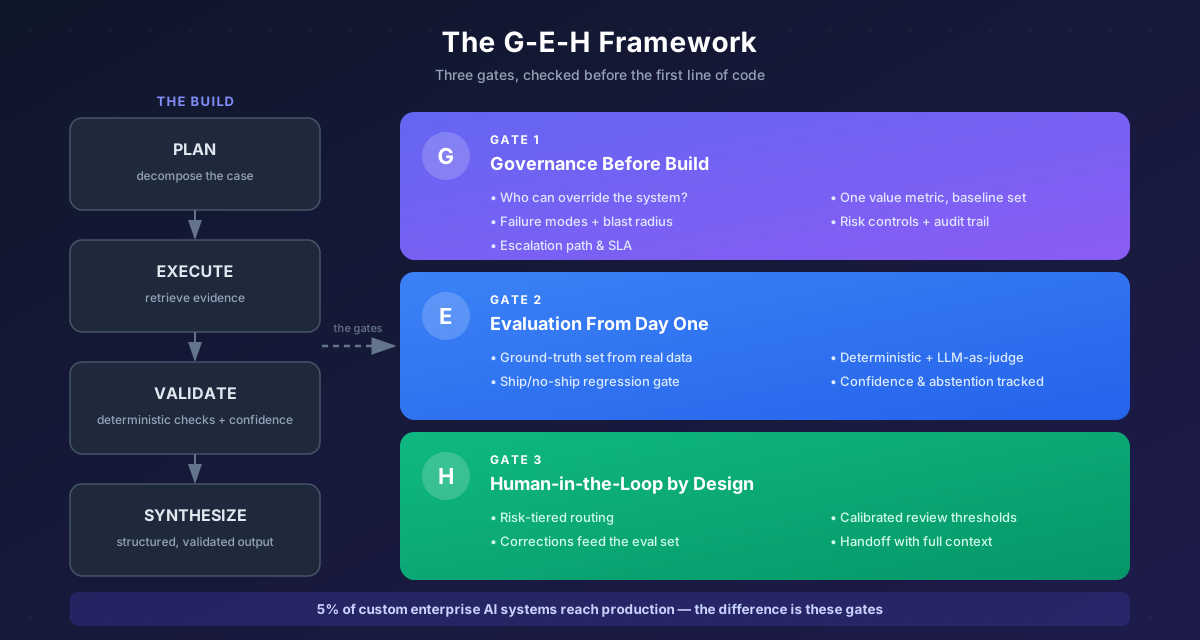
The framework is deliberately small. Three gates, each answerable in a week of focused work — and each one dramatically more expensive to retrofit later. Here's what each gate requires.
Checkpoint 1 — Governance Before Build
Governance, for an implementation team, is not a compliance deck. It's a one-to-three-page decision register that answers five questions before any code exists:
- Decision authority. Which outputs can act automatically? Which require approval? Who holds the approval? And — the question that separates teams that ship from teams that stall — who can override the system when it's wrong, by what mechanism?
- Failure modes. The top failure modes, enumerated explicitly — a hallucinated entity, a policy violation, stale data, a misrouted action — and for each one: how it is detected, what the blast radius is, and what the default response is (retry, freeze, revert, route to human).
- Escalation path. Who is notified, within what time, and what the system does while it waits for a human. An AI system that cannot say “I'm not confident, I'm pausing, and I've paged the right person” is not production-ready, whatever its accuracy.
- Value metric. One primary business KPI with an agreed baseline and target, measured before and after. This is the direct answer to Gartner's “unclear business value” — and it's the only metric the business will hold you to.
- Risk controls. Data boundaries (what the model can and cannot see), PII handling, model and prompt versioning, and an audit trail of every decision the system makes. Note the last one: audit logging must be designed into the architecture. You cannot log decisions the system was never instrumented to record.
The test is simple: if the register can't be written in a week, the project isn't ready to start. Not because the register is the hard part — but because if you can't answer the five questions now, you won't be able to answer them after launch, when the stakes are real.
Checkpoint 2 — Evaluation Architecture From Day One
You can't improve what you can't measure — and for AI systems, “measure” has to mean more than “it didn't crash.” A standing evaluation architecture has five components:
- A ground-truth set. Labeled examples drawn from real operational data — not vendor samples, not the happy-path inputs from the demo. In a case-processing system, that's historical cases with known-correct answers, curated with the domain experts who will review the system's output.
- Deterministic checks. Schema validation, allowed domains, policy constraints — run in code, not in a prompt. If an output fails a deterministic check, it fails, full stop; no model gets to argue.
- LLM-as-judge on quality dimensions. For what code can't check — relevance, completeness, coherence — a second model scores outputs against a rubric, with a human-audited subset to keep the judge itself honest.
- Confidence and abstention as first-class metrics. The system reports confidence on every output, and the abstention rate — the share of cases where the system says “I'm not sure, I'm routing this to a human” — is tracked as a health signal. A rising abstention rate is early warning of input drift. A falling one, on its own, is a warning too: it can mean the system has learned to answer everything, which is exactly what you don't want from a system in a regulated workflow.
- A regression harness with a ship/no-ship threshold. Every change — a new model, a prompt edit, a change to retrieval — runs the full set against a baseline. Below the threshold, it doesn't ship. This is what makes the “better model” fallacy solvable: model swaps become a measured decision instead of a leap of faith.
In practice this is an evaluation platform — Langfuse in the implementation described below — with traces on every agent node, judges over sampled production traffic, and dashboards the business can actually read. The point is not the tool. It's that the measurement system exists before the first production request, because you cannot retrofit telemetry into a graph that was never instrumented.
Checkpoint 3 — Human-in-the-Loop by Design
McKinsey's 2025 research is unusually specific here: among the practices that separate the ~6% of AI high performers from everyone else, one of the strongest is having defined processes that determine how and when model outputs need human validation to ensure accuracy. That's not a nice-to-have. It's one of the measured predictors of whether an organization captures value from AI at all.
Designed-in human-in-the-loop (HITL) has four components:
- Risk-tiered routing. Outputs are classified by consequence, not by model confidence alone. A field that feeds a financial commitment routes to review; a summary field routes to the auto-queue with sampling. The tiers come from the governance register — Checkpoint 1 feeds this one.
- Calibrated confidence thresholds. The system reports confidence per output, and the threshold that triggers human review is a tuned product decision. Set it too high and you've built a human-copy machine that never saves the business its cost; set it too low and you've shipped a trust problem. You tune it against the measured error rate of auto-resolved outputs — and you re-tune it every time the model changes.
- A handoff protocol that respects the reviewer. When a case routes to a human, they see the model's output, its confidence, the evidence the model used, and one-click actions: approve, correct, reject with reason. The reviewer's corrections are captured as structured data — because every correction is a labeled example the evaluation set didn't have.
- The flywheel. Corrections feed back into the ground-truth set and the regression harness. The system gets better not in a “retraining event” but continuously, on the organization's own data. This is the part executives love to hear about, and it only works if Checkpoint 2 and Checkpoint 3 were both built from day one.
The anti-pattern to recognize in any vendor pitch or internal roadmap: “we've added a human reviewer.” A queue bolted onto an end-to-end workflow, with no defined thresholds, no context at handoff, no capture of corrections. That's HITL as a guilt mechanism. It doesn't build trust; it documents the gap.
What It Looks Like in Production
An anonymized engagement shows what the three checkpoints look like when they're actually in the architecture: a large financial services client, with a case-processing workflow where the system extracts and validates eight business-critical attributes from case documents.
The core is a LangGraph plan-execute-validate-synthesize workflow: the planner decomposes the case, the executor retrieves evidence, the validator checks the extracted attributes against deterministic rules, and the synthesizer assembles the final structured output. Three details carry the weight.
Every node emits Pydantic-validated, structured output. Agent outputs are typed and schema-validated at the boundary. An invalid output doesn't “get close enough and hope” — it fails validation, triggers a bounded retry with the validation error in context, and if it still fails, routes to human review with the failure attached. The model can be wrong; the system can't be loose.
Guardrails run in code, outside the model. Attribute values are checked against allowed domains, ranges, and cross-field consistency rules by deterministic logic — not by asking a prompt to “please be compliant.” This is what makes the outputs auditable: every rejection carries a rule identifier, a timestamp, and the input that triggered it. That audit trail is Checkpoint 1, requirement five — and it exists only because it was designed in, not bolted on.
Confidence decides routing. For each of the eight attributes, the validator produces a confidence score. Attributes above the team-agreed threshold, in the right risk tier, complete the case automatically. Anything below threshold — or failing a deterministic check — routes to a reviewer with full context: the extracted value, the confidence, the source-document span the model cited, and one-click correct-and-release. Reviewer corrections are captured and periodically promoted into the evaluation set.
What the client got was not a model. It was a system with a known failure distribution, a measurement system that tells the truth, and a designed handoff to humans. And because those three things were in the architecture from day one, the system stays built — still running, still improving against its own evaluation set, still trusted by the operations team. “Stays built” is the whole game. It isn't a feature; it's the sum of the three checkpoints.
What I'd Do Differently
The honest version: I didn't get all three right, on time, on that engagement.
The ground-truth set was treated as a data task instead of a domain task. The first labeled set was assembled quickly from “obvious” historical cases, and it measured what the model was good at — not what the workflow feared. Re-cutting the set after launch, around the operations team's actual distribution of edge cases, took weeks. The lesson I now carry into every engagement: ground-truth curation is a domain problem, and the people who run the workflow must drive it, from the first curation session.
The HITL thresholds were set on a guess, not calibrated. For the first few weeks the system either routed too aggressively — the business saw a cost center — or not aggressively enough — the operations team saw a trust gap — and I spent real relationship capital earning back what a calibration exercise would have given me on day one. The fix, when it came, was unglamorous: log every correction, compute the error rate of auto-resolved outputs by risk tier, and set the threshold from data.
The governance register was a document, not a living artifact. It existed for two weeks and then bit-rotted. When the model was upgraded, nobody could point to the decision that said which outputs the new model was allowed to act on automatically, and we had to re-derive it in a meeting. If I were running it today, I'd version the register with the model and the prompts — every model or prompt change paired with a diff of the decisions it affects — so governance stays as current as the code it governs.
The pattern under all three is the one the framework tries to enforce: each checkpoint is cheap before the build and expensive after it. The version that cost the least and bought the most trust was the one that existed in the architecture before the first production request.
FAQ
What's the most common reason AI pilots fail?
Not the model. The independent evidence points at the same three causes: unclear business value, inadequate risk controls, and brittle integration with real workflows — Gartner's stated reasons for the predicted 40%+ cancellation of agentic AI projects by 2027, and MIT NANDA's “brittle workflows, lack of contextual learning, misalignment with day-to-day operations” behind the 95% that return zero value. All three are implementation decisions that can — and should — be made before code is written.
How do I evaluate my organization's AI readiness?
Run the three checkpoints as a 90-minute audit. Can you answer the five governance questions — authority, failure modes, escalation, value metric, risk controls — in writing? Can you show a measurement system that tells you whether quality went up or down this month? Can you describe, in one sentence, when a human takes over? Every gap you find is a real project. And the good news is that the gaps are almost always answerable in weeks, not quarters.
What does “governance” actually mean for an AI project?
A decision register, not a committee. A one-to-three-page document that answers: who can override the system, what the enumerated failure modes do, who gets paged and how fast, which business KPI decides success, and what data the model is and isn't allowed to see. If that document can't be written in a week, the project isn't ready to start.
Do I need human review for every AI output?
No — that would just transfer the work. Tier outputs by consequence: low-risk outputs auto-complete with sampled review, high-risk outputs route to a human by default, and the thresholds are calibrated from the measured error rate of auto-resolved outputs. The goal is that the human's time goes where the risk is — and that the system knows, and can show, which outputs it handled alone.
Does this apply to a small team or a startup?
Proportionally, yes — arguably more, because a small team can't absorb a trust failure. A one-page decision register, a 100-example evaluation set from your own data, and a written “when do we call a human” rule take an afternoon to build, and they're the same three checkpoints a 5,000-person enterprise needs, at startup scale.
The Takeaway
The organizations that close the demo-to-production gap aren't the ones with the better model. They're the ones that answered three questions before writing code: who's in charge when it's wrong, how will we know, and when does a human take over.
If your AI pilot is stuck between demo and production, the gap is almost certainly in these three checkpoints — not in the model. Each one is a week of focused work, and together they're the difference between a system that stays built and one that dies at the pilot wall.
Running an AI pilot that isn't reaching production? Use the contact section below and we'll start with the 90-minute readiness audit.
Get in Touch
Want to collaborate or just say hi? Reach out!